A plain-English guide to IS 14665 — India's elevator safety standard. What it covers, the safety devices your lift must have, who is responsible for compliance, and the questions to ask any elevator company before you sign.
What is IS 14665?
IS 14665 is the Bureau of Indian Standards' code for electric traction lifts — the rulebook that governs how passenger and goods elevators in India must be designed, manufactured, installed and tested. It spans multiple parts covering safety rules, dimensions, ropes, doors, brakes, controllers and inspection procedures. When an elevator company says their lift is 'IS 14665 compliant', they are claiming conformity with this code. Your job as a buyer is to make them prove it — every Vila elevator ships with test certificates you can verify.
The safety devices IS 14665 expects — your checklist
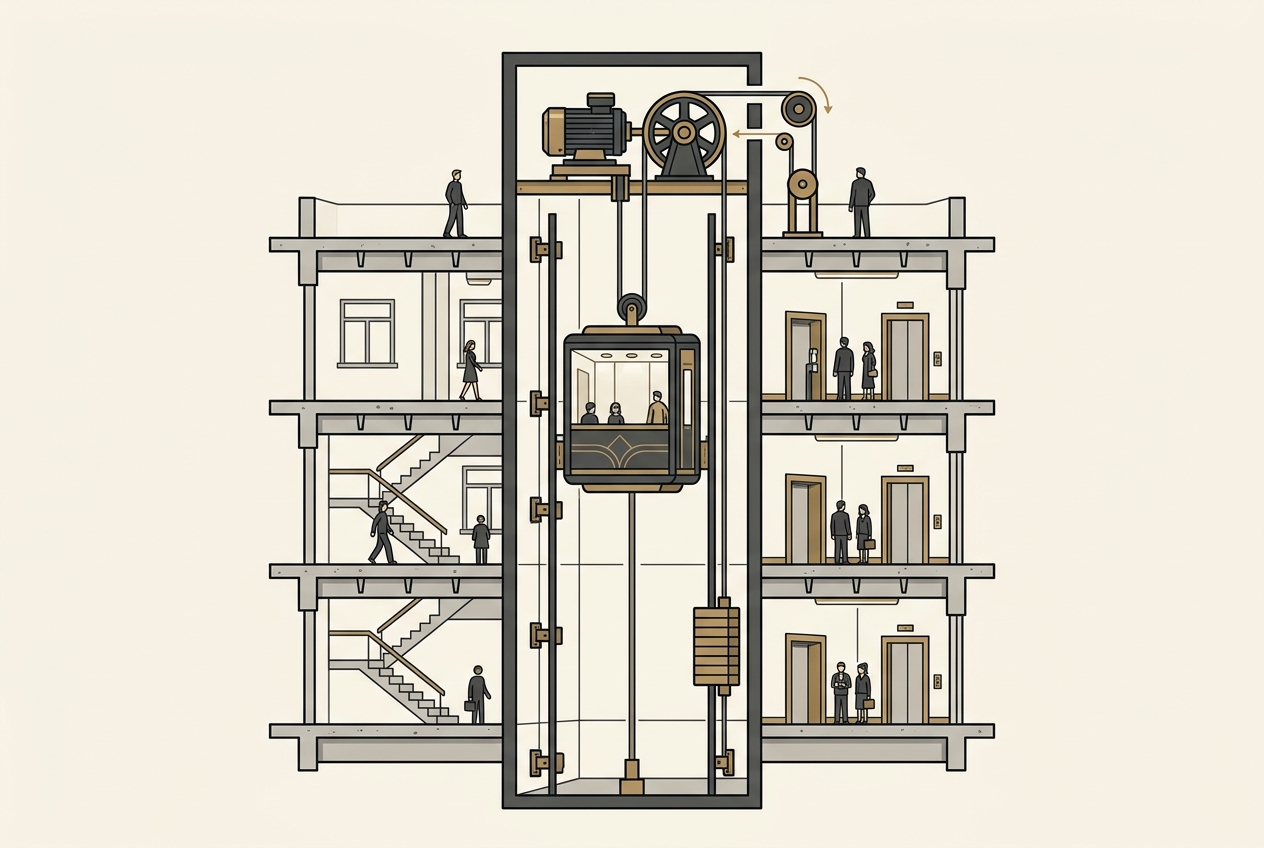
Overspeed governor and safety gear that clamp the car to the rails if it moves too fast. Electromagnetic brakes that hold the car on power loss. Door interlocks so the lift cannot move with doors open. Door safety curtains (infrared arrays) that reverse closing doors when a person or object is detected. Overload sensors that keep the lift parked when capacity is exceeded. Emergency alarm and two-way communication from inside the cabin. Automatic Rescue Device (ARD) that brings the cabin to the nearest floor and opens the doors during power failure — essential for Indian power conditions. If a quotation is vague about any of these, walk away.
Who is responsible for compliance? (Hint: also you)
The manufacturer is responsible for building to code. The installer is responsible for erecting and commissioning to code. But under state lift rules — including the Karnataka Lifts, Escalators and Passenger Conveyors Act — the building OWNER is responsible for keeping the lift licensed, inspected and maintained once it is running. That means periodic inspections, a current licence for commercial buildings, and documented maintenance. An AMC with written service reports is not a luxury; it is your compliance paper trail.
Karnataka lift licensing in practice
In Karnataka, commercial and multi-dwelling buildings need a lift licence: an erection permission before installation, followed by a working licence after inspection, renewed periodically. Private single-family homes are generally exempt from commercial licensing, though safety standards still apply. Vila prepares the complete technical documentation package — drawings, load calculations, test certificates — and supports the application end to end, which is one advantage of buying from a Karnataka-based manufacturer that deals with these offices every week.
Maintenance is a safety requirement, not an option
IS 14665's safety intent collapses without upkeep: ropes stretch, brakes wear, door sensors drift. Monthly preventive maintenance visits, quarterly safety audits and genuine spare parts are what keep a compliant lift compliant. Vila's IoT-monitored lifts add a digital safety layer — continuous brake-torque, door-cycle and leveling data with automatic alerts, so deviations are corrected before they become hazards. Buildings running monitored AMCs see roughly 30–40% fewer emergency events.
Five questions that separate serious companies from the rest
1) Show me the IS 14665 test certificates for this exact model. 2) Is the ARD standard or a paid extra? (At Vila: standard.) 3) What is your written breakdown-response SLA? 4) Who handles the Karnataka lift licence paperwork? 5) Can I visit your factory and see these safety systems being built? A manufacturer with nothing to hide answers all five without flinching — and the answers should be in your contract, not just the conversation. For a compliant, safe elevator with the paperwork done right, call Vila at +91 90712 21100.
Get a personalized quote for your building.
Our engineering team will review your requirements and respond within one business day.
Request A Quote